
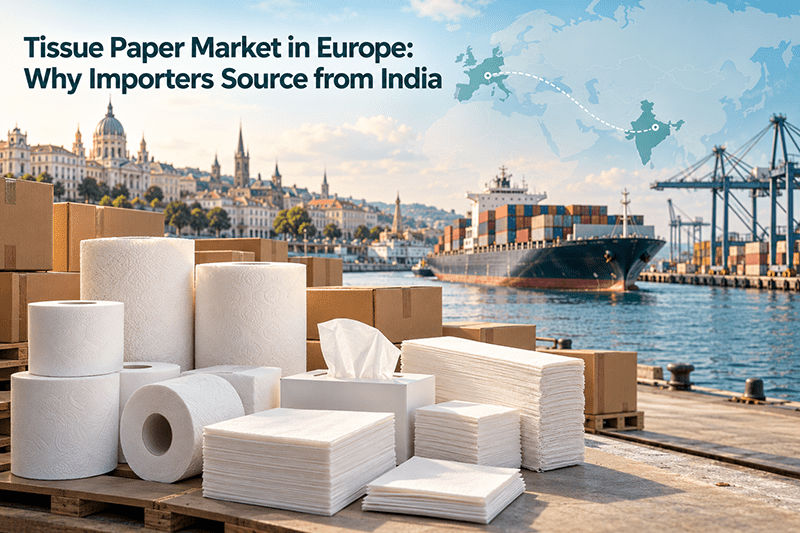
What drives the tissue paper market in Europe
The tissue paper market in Europe is mature, but it is far from static. Household buyers expect consistent softness and strength, while hotels, restaurants, offices and hospitals buy large volumes of towels, napkins and dispenser tissue every week. Hygiene habits formed in recent years have stayed, and food service keeps growing in cities and tourist regions. For importers, the opportunity lies in reliable supply, private label flexibility and competitive landed cost.
Energy and pulp costs have also reshaped the region. European mills face high operating costs, so many wholesalers and retail brands now compare local offers with imports from Asia. Buyers are not looking only for the lowest price: they want certified quality, clean paperwork and a supplier that understands European packaging, labelling and documentation. That combination creates room for well organised Indian manufacturers who ship consistent containers on schedule.
Demand also varies across the continent. Northern and western countries lean towards premium softness, recycled content debates and strong private label programmes, while southern and eastern markets often favour value packs and robust away-from-home products. Tourist regions see sharp seasonal peaks in hotel and restaurant consumption. An importer who understands these regional patterns can plan product mix, pack sizes and stock levels far better than one treating Europe as a single market.
Buyer segments in the European tissue market
Three segments matter most. Retail covers supermarkets, discounters and online stores selling toilet rolls, kitchen towels and facial tissue, often under private label. The away-from-home segment includes hotels, restaurants, catering firms, offices and cleaning contractors that use M-fold and L-fold tissue, jumbo rolls and napkins. Finally, events and party retail buy coloured and printed napkins, where design and seasonal ranges drive repeat orders.
Each segment buys differently. Retail buyers run formal tenders, ask for detailed specifications and expect promotional support, but they commit to large, regular volumes. Hospitality and away-from-home customers buy through catering and janitorial distributors who value fast delivery and a wide range from one source. Party retail moves quickly, with short design cycles, so importers there need flexible reorders and attractive packaging more than the lowest unit price.
| Buyer segment | Typical products | What they value |
|---|---|---|
| Supermarkets and discounters | Toilet rolls, kitchen towels, facial tissue | Private label packs, steady pricing |
| Hotels and restaurants | Dinner and bar napkins, box tissue | Softness, presentation, logo printing |
| Offices and cleaning contractors | M-fold towels, toilet rolls | Dispenser fit, absorbency, cost per use |
| Party and gift retail | Printed party napkins | Designs, seasonal ranges, pack sizes |
EU rules that affect tissue paper importers
Napkins and kitchen towels that may touch food fall under the EU food contact framework, Regulation (EC) 1935/2004, so buyers often ask for declarations of compliance and test reports. Sustainability expectations are strong: FSC certification helps retailers support their responsible sourcing policies. Labelling must follow the language and consumer rules of each country you sell in. Work with your importer of record or a compliance adviser to confirm exactly what each retail customer needs.
Tableware sits under separate rules. The EU Single-Use Plastics Directive (2019/904) has pushed food service operators towards fibre and paper alternatives, which is why many tissue importers now add bagasse plates and bowls to their range. If you plan to do the same, request compostability test reports against EN 13432 from your supplier, and confirm how each country treats compostable claims on packaging and in marketing.
HS codes and duty for the tissue paper market in Europe
Toilet paper, facial tissue, towels and napkins are usually classified under HS heading 4818; confirm the exact code with your customs broker. Duty in the EU depends on the full commodity code, the origin of goods and any trade preference that applies. Rather than relying on figures quoted online, check the current rate on the EU TARIC database, and add VAT and clearance costs to work out your true landed cost.
Classification errors are expensive to fix later. A napkin pack with a printed design, a boxed facial tissue and a jumbo roll for dispensers may carry different codes, so share product photos and specifications with your broker before the first shipment. Keep a simple classification sheet for every SKU you import, and update it whenever you add a new product, pack format or packaging material.
Why European importers source tissue from India
India offers a mix of competitive manufacturing, certified quality and flexible order sizes. White Orchid makes tissue from 100% virgin pulp at Santej near Ahmedabad and holds ISO 9001, ISO 14001, ISO 22000, GMP and FSC certification. Western Indian ports such as Mundra, Pipavav and Nhava Sheva have regular sailings to European ports. Private label on poly bags, boxes and master cartons helps importers build their own brand with a sensible MOQ.
Mixed containers are another advantage. A new distributor can combine tissue napkins, facial tissue and toilet rolls in a single shipment, test several product lines with one freight cost, and then scale the winners. Sea transit to Europe typically takes several weeks, depending on carrier, route and season, so plan orders around a rolling forecast rather than urgent top-ups.
European buyers rarely switch suppliers on price alone. They switch when a new source proves it can match quality, paperwork and delivery rhythm, container after container.
Distribution channels for tissue in Europe
Most imported tissue reaches end users through a few channels: national importers who supply wholesalers, cash and carry groups, catering and janitorial distributors, and retail chains buying private label directly. Online marketplaces are growing for multi-packs and catering supplies. Pick one or two channels you can serve well first. A focused importer with strong relationships in hospitality often grows faster than one trying to supply every retailer at once.
- Confirm the full commodity code and duty rate on EU TARIC before pricing.
- Request food contact declarations for napkins and towels used around food.
- Use FSC certification to support retail and corporate responsible sourcing policies.
- Start with a mixed container to test several tissue lines together.
- Plan packaging artwork in local languages well before the first production run.
Partner with White Orchid for the European market
White Orchid is appointing importers and distributors across Europe for tissue napkins, toilet rolls, kitchen towels, facial tissue and multi-fold tissue. We ship under EXW, FOB, CFR, CIF or door delivery terms, by sea or air. Review our certifications, then contact White Orchid on +91 9825109781 or info@whiteorchidtissue.com to discuss specifications, private label and a trial container.
Frequently Asked Questions
Which HS code is used to import tissue napkins into the EU?
Tissue napkins are usually classified under HS heading 4818. The exact eight or ten digit code depends on the product form, so confirm it with your customs broker and check the current duty on EU TARIC.
Do European retailers require FSC certified tissue?
Many European retailers and corporate buyers prefer or require FSC certified products to meet responsible sourcing policies. White Orchid holds FSC certification, which helps importers supply these customers with confidence.
How long does sea freight take from India to Europe?
Sea transit from western Indian ports to major European ports typically takes several weeks. Times vary by carrier, route, transhipment and season, so build a buffer into your stock planning.
Can I order a mixed container of tissue products from India?
Yes. White Orchid can load napkins, toilet rolls, kitchen towels and facial tissue in one container, which helps new importers test several product lines while sharing a single freight cost.