
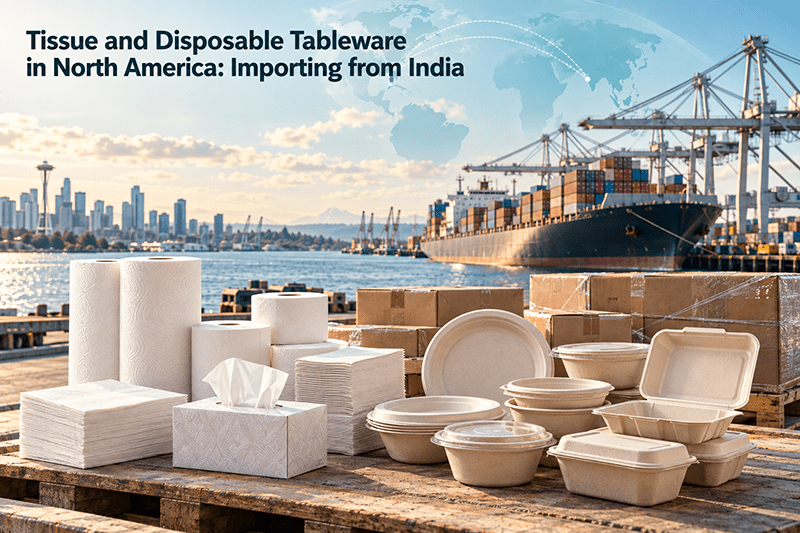
Demand for tissue and disposable tableware in North America
The market for tissue and disposable tableware in North America is shaped by a strong takeout and delivery culture, large institutional buyers and a steady shift away from foam and plastic in food service. Restaurants, cafeterias, stadiums, offices and healthcare facilities buy napkins, towels and toilet tissue in very large volumes. At the same time, operators are replacing plastic containers with fibre-based options that meet customer and regulatory expectations.
The three countries behave differently. The USA is the largest and most segmented market, with national chains and thousands of regional distributors. Canada has a concentrated retail sector and active municipal and federal action on single-use plastics. Mexico combines a fast growing modern retail and quick service sector with a large traditional market. An importer should decide early which country and which segment to serve first.
Sustainability pressure comes from several directions. Large restaurant chains publish packaging commitments, universities and corporate campuses set their own green procurement rules, and many consumers now expect takeout food in fibre packaging rather than foam. This steady pressure favours plant-based tableware such as sugarcane bagasse, provided suppliers can show that products are strong, grease resistant and supported by proper documentation for the markets where they are sold.
Key buyer segments across the USA, Canada and Mexico
Foodservice distributors supply restaurants, schools and caterers with napkins, bagasse clamshells and containers. Janitorial and sanitation (jan-san) distributors serve offices, hospitals and facilities with M-fold towels and toilet rolls. Retail chains and discount stores buy household packs, often under private label. Online sellers focus on catering packs, party napkins and eco tableware bundles, where good packaging and consistent supply build ratings.
Buying behaviour differs by segment. Large distributors issue formal vendor applications, insurance requirements and product specification sheets, and they may run long trials before listing. Independent restaurants and regional caterers buy smaller quantities but decide faster. In Mexico, relationships and local representation matter, and many buyers prefer Spanish language documents. Plan your sales approach around how each segment actually makes purchasing decisions, not just around price lists.
| Product line | Main buyers | Buying priority |
|---|---|---|
| Tissue napkins and dinner napkins | Restaurants, caterers, party retail | Presentation, pack count, logo printing |
| M-fold towels and toilet rolls | Jan-san distributors, facilities | Dispenser fit, cost per use |
| Bagasse plates, bowls and clamshells | Foodservice distributors, takeout | Strength with hot food, compostability |
| Thermal POS rolls | POS dealers, retailers, restaurants | Standard sizes, BPA free, print clarity |
Food contact, PFAS and compostability rules
Food contact items sold in the USA must meet US FDA food contact requirements, and buyers commonly ask for supporting documents. Several US states now restrict intentionally added PFAS in food packaging, so distributors ask suppliers to confirm PFAS status for moulded fibre products. For compostable claims, buyers look for test reports against standards such as ASTM D6400. Always ask your supplier for current reports and check the rules in every state or province you sell into.
Canada and Mexico have their own frameworks. Canadian buyers pay close attention to federal and provincial rules on single-use plastics and to bilingual labelling requirements for retail packs. Mexican importers work with local health and labelling regulations and use customs agents for clearance. Rather than assuming one set of documents fits all three countries, prepare a compliance checklist for each and review it with your broker and customers.
HS codes and duty for tissue and tableware imports
Tissue products are usually classified under HS heading 4818, and bagasse tableware usually under 4823, often 4823.70 for moulded pulp articles. Thermal rolls can fall under 4811 or 4823 depending on form. Confirm the exact code with a licensed customs broker, then check duty on the US HTS through USITC, the CBSA customs tariff for Canada, or Mexican customs, and add brokerage, port and inland costs.
Why importers bring tissue and disposable tableware from India
India combines competitive manufacturing with a broad product range under one roof. White Orchid produces virgin pulp tissue, BPA free thermal POS rolls in the common 3 1/8 inch x 230 ft size, and sugarcane bagasse tableware, all at Santej near Ahmedabad. Certifications include ISO 9001, ISO 14001, ISO 22000, GMP and FSC. One supplier for several categories simplifies audits, documentation and freight planning for North American importers.
Transit from Mundra, Pipavav or Nhava Sheva to East Coast, West Coast or Gulf of Mexico ports typically takes several weeks and varies by carrier, route and season. Many importers ship to one port and distribute by truck. Mixed containers of containers with lids, plates and napkins let you launch a full takeout range with one freight booking and one set of documents.
In North America, winning a foodservice distributor often depends on paperwork as much as product. Clean compliance files open doors that samples alone cannot.
Building a sales channel in North America
Start by choosing a clear route to market. Some importers sell to regional foodservice or jan-san distributors, others supply restaurant groups directly, and some build an online brand. Each route needs different pack sizes and paperwork. Prepare a product catalogue with specifications, case dimensions and pallet patterns, because North American buyers plan warehouse space by pallet and expect this information before quoting.
Trade shows, sample programmes and distributor visits remain important in this region. Buyers like to test napkin softness, clamshell strength and print quality before committing, so budget for sample shipments by air. Once a product is listed, consistent quality across containers matters more than anything else. A single shipment with weak lids or mismatched pack counts can undo months of relationship building with a distributor.
- Confirm HS codes and duty with a licensed customs broker before quoting prices.
- Ask for PFAS status and compostability test reports for all bagasse products.
- Match thermal roll sizes to the printers your customers already use daily.
- Share case dimensions and pallet patterns with distributors early in discussions.
- Use mixed containers to launch a complete takeout range in one shipment.
Work with White Orchid for North American supply
White Orchid is appointing importers and distributors in the USA, Canada and Mexico for tissue, thermal rolls and bagasse tableware. We offer private label on poly bags, boxes and master cartons, and logo printing on napkins and thermal rolls, each with an MOQ. Explore our company background, then contact White Orchid on +91 9825109781 or info@whiteorchidtissue.com to request samples and a quotation.
Frequently Asked Questions
Is bagasse tableware from India accepted by US foodservice distributors?
Yes, many distributors buy moulded fibre tableware from India. They typically ask for food contact documents, PFAS status and compostability test reports, so request these from your supplier before listing products.
What thermal roll size is most common in the USA?
The 3 1/8 inch width is standard for most retail POS receipt printers, with 230 ft a popular length. The 2 1/4 inch width suits many card terminals and mobile printers.
How do I find the import duty on tissue in Canada?
Identify the likely HS code, usually under heading 4818 for tissue, then check the rate in the CBSA customs tariff. A customs broker can confirm the exact classification and any origin rules.
Can I import from India to Mexico and the USA in the same order?
Usually each country needs its own shipment and documents, as customs clearance is national. You can still order the same specifications and packing for both, which keeps branding and planning simple.