
Why Single Use Plastic Bans Matter to Tableware Importers
Governments across the world are restricting single use plastic items such as plates, cutlery, straws, stirrers and foam food containers. For importers and distributors of eco tableware, each new ban shifts buyers away from cheap plastic and towards alternatives made from paper, wood or moulded fibre. The shift is rarely overnight, but it is steady, and distributors who build supply chains early usually win the contracts when enforcement tightens and customers need a compliant option quickly.
The details differ by country, so it pays to understand the broad patterns rather than chase every headline. Below we look at the main regions, the kinds of products typically targeted and the practical steps an importer can take to stay ahead of the rules.
The EU Single Use Plastics Directive and Its Ripple Effect
The EU Single-Use Plastics Directive (2019/904) restricted several plastic items from the EU market, including plastic plates, cutlery and expanded polystyrene food and drink containers. Member states also apply their own measures on top, such as consumption reduction targets and extended producer responsibility schemes. Because the EU is a large, closely watched market, its rules have influenced regulators in the UK, neighbouring countries and trading partners who want their own producers to meet similar expectations.
For importers, the directive created demand not just for any plastic free plate, but for products backed by documentation. Buyers in the EU typically expect food contact compliance under Regulation (EC) 1935/2004, clear material descriptions and, where compostability is claimed, supporting test reports against EN 13432.
India, Africa and the Gulf: Different Paths to Plastic Bans
India banned a list of identified single use plastic items in 2022, which boosted domestic demand for bagasse and paper alternatives. In Africa, Rwanda was an early mover on plastic bags, and Kenya introduced a strict plastic bag ban in 2017. In the Gulf, the UAE has adopted a phased federal approach to single use plastic products. Each of these markets combines bans, levies and public campaigns, and the scope often widens over time.
| Region | Typical approach | What importers should watch |
|---|---|---|
| European Union | Directive restricting listed plastic items | Food contact documents, compostability claims |
| India | Ban on identified single use plastic items | Domestic distributor demand, certification |
| East Africa | Strict bans on plastic bags, wider scrutiny | Customs enforcement, alternative materials |
| UAE and Gulf | Phased federal restrictions | Conformity rules, such as SABER in Saudi Arabia |
| United States | State and city level rules, PFAS limits | State by state packaging requirements |
What Plastic Bans Mean for Eco Tableware Demand
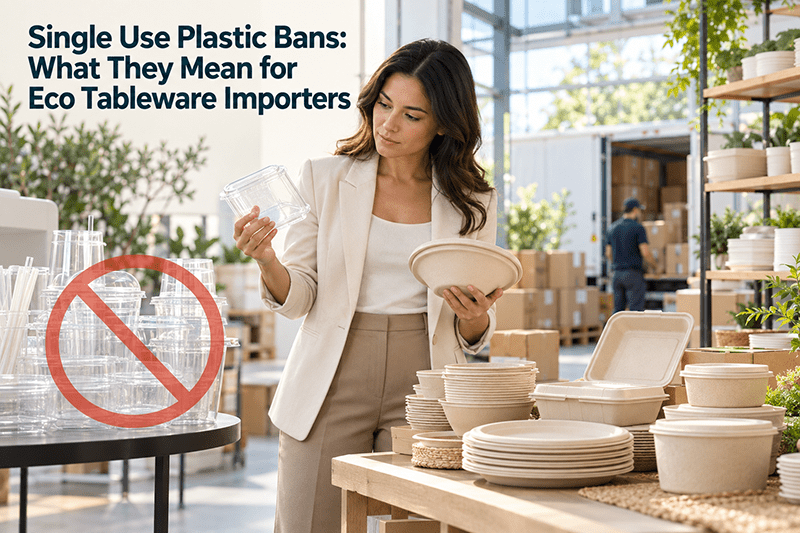
When plastic plates and foam boxes disappear, caterers, restaurants, takeaway outlets and event organisers still need something to serve food in. Bagasse plates, clamshell boxes and containers with lids are natural replacements because they handle hot, wet and oily food. Demand usually rises first in foodservice, then in retail as supermarkets and online shops respond to customers looking for plastic free picnic and party supplies.
Paper based items gain too. Restaurants that drop plastic often review the whole table setting, which can lift orders for tissue napkins and other paper disposables sold alongside eco tableware.
Expect the product mix to change as the market matures. Early demand tends to focus on basic round plates and clamshells for takeaway. Later, buyers ask for compartment plates, meal trays, bowls in several sizes and containers with matching lids for delivery. Planning your range in stages lets you manage cash flow while still being ready when larger foodservice customers ask for a complete plastic free solution.
Compliance Risks Importers Should Not Ignore
A plastic ban does not automatically make every alternative compliant. Some moulded fibre products use additives for oil resistance, and several US states restrict PFAS in food packaging. Compostability claims can attract scrutiny from consumer protection authorities if they cannot be supported. Saudi Arabia requires many imported goods to go through the SABER conformity platform. Before committing to a large order, confirm the rules for your destination with a customs broker or local regulatory consultant.
Customs classification is another practical point. Moulded fibre tableware is usually classified under HS heading 4823, but you should confirm the exact code for your market, because the code decides the duty rate and any documents required at the border. Getting this right before the first shipment avoids delays at the port and unexpected costs.
A plastic ban creates demand, but documentation wins the order. Importers who can show food contact and compostability evidence close contracts faster than those selling on price alone.
How Eco Tableware Importers Can Prepare for Plastic Bans
The best time to build an eco tableware range is before a ban takes effect in your market. Start with a core set of fast moving items, secure reliable supply and gather the documents your customers will ask for. Then expand into specialised shapes once you understand local demand. A practical preparation plan covers the following points.
- Track draft regulations in your country and note which items are likely targeted.
- Build a core range of plates, bowls and clamshells in popular standard sizes.
- Collect food contact test reports and additive declarations from your manufacturer early.
- Ask for compostability test reports if you plan to make compostable claims.
- Consider private label packaging so your brand, not the factory, builds loyalty.
Choosing a Reliable Eco Tableware Manufacturer
Plastic bans reward importers who can deliver consistently. Look for a manufacturer with documented quality and food safety systems, clear export experience and a product range wide enough to cover most foodservice needs. Ask about lead times for standard items, packing formats and how the factory handles repeat orders. Visiting in person or through a video call helps confirm that the production line matches the catalogue and that samples reflect real output.
Also check how flexible the supplier is on shipping terms. Some importers want FOB so they can use their own forwarder, while smaller distributors often prefer CIF or door delivery so they receive a single landed price and avoid managing ocean freight themselves.
Partner With White Orchid on Plastic Free Tableware
White Orchid manufactures bagasse plates, bowls, clamshells and containers, alongside tissue and paper products, at Santej near Ahmedabad. We hold ISO 9001, ISO 14001, ISO 22000, GMP and FSC certifications and ship on EXW, FOB, CFR, CIF and door delivery terms. We are appointing distributors and importers in markets moving away from plastic. See our certificates and contact us or WhatsApp +91 9825109781 to discuss your range.
Frequently Asked Questions
Which plastic items are usually banned first?
Plastic bags, straws, cutlery, plates, stirrers and expanded polystyrene food containers are commonly among the first targets. The exact list varies by country, so check your national regulation or ask a local trade association.
Is bagasse tableware accepted where plastic plates are banned?
Bagasse tableware is plastic free and widely used as a replacement for plastic plates and foam boxes. Still check local rules on food contact, additives and labelling claims before importing into a new market.
Do plastic bans apply to importers or only to retailers?
Depending on the country, bans can apply to manufacture, import, distribution and sale. Importers should assume the rules affect them and confirm details with customs or a regulatory consultant before shipping.
How can a new importer enter the eco tableware market?
Start with a small range of fast moving plates, bowls and clamshells, gather food contact and compostability documents, test demand with local foodservice buyers, then scale with a reliable manufacturer and private label packaging.