
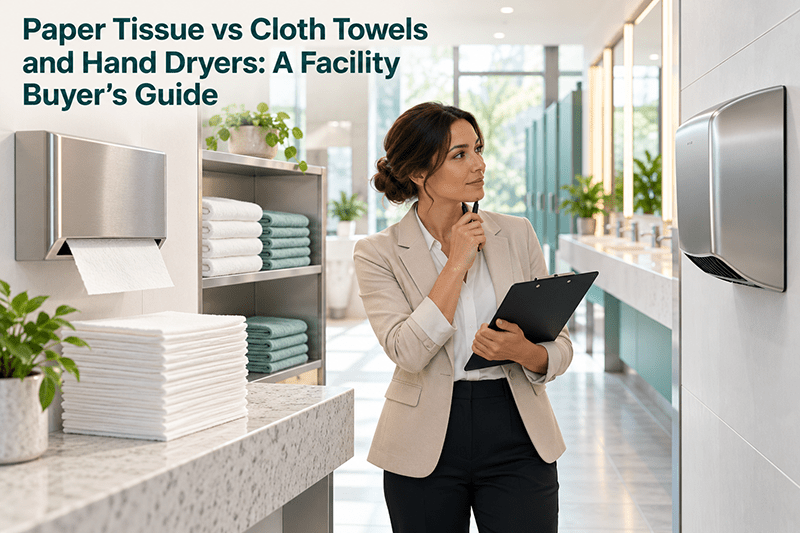
Paper Tissue vs Cloth Towels and Hand Dryers: Why the Choice Matters
Hand drying looks like a small detail, yet for facility managers it affects hygiene, user satisfaction, maintenance workload and sustainability reporting. The comparison of paper tissue vs cloth towels and hand dryers comes up in offices, hospitals, schools, restaurants, hotels and factories. Each option has strengths, and the right answer depends on footfall, the type of users and how well the washroom is serviced. This guide sets out the trade-offs in practical terms.
Hygiene authorities broadly agree that drying hands thoroughly after washing is an important part of hand hygiene, because damp hands transfer microorganisms more easily than dry ones. So the question is which method dries hands well, quickly and consistently in your setting.
Hygiene Performance of Paper Hand Towels
Single use paper towels dry hands through absorption and friction. Rubbing hands with a fresh towel helps remove residual moisture and loosened microorganisms, and the towel is then thrown away. Each user gets a clean surface. Paper towels can also be used to turn off taps and open doors, which many hygiene conscious users appreciate. For these reasons, paper is common in healthcare, food preparation areas and other settings where hygiene is the top priority.
Quality matters, though. Thin, weak towels tear when wet, so users pull several at once, which raises consumption and cost. A towel with good absorbency and wet strength dries hands with one or two sheets. When comparing suppliers, test towels in real conditions rather than judging by price per case alone, because the cost per hand dry is the number that really affects your budget.
Cloth Towels: Comfortable but Demanding to Manage
Cloth roller towels and hand towels feel pleasant and can suit low traffic, well staffed areas such as executive washrooms or small hotels. The challenge is management. A shared cloth towel quickly becomes damp and is touched by many users, so it must be changed frequently. Roller systems reduce shared contact, but they rely on regular servicing and laundering contracts. If servicing slips during busy periods, hygiene suffers faster than with disposable paper.
Cloth also brings hidden operational costs. Someone must track towel stock, check roller cabinets, record collections and manage the laundry contract. In multi site operations, such as hotel groups or school networks, those tasks multiply. Paper and dryers are simpler to standardise across locations, which is one reason larger organisations often phase cloth out of shared washrooms and keep it for guest rooms.
Hand Dryers: Low Waste but Mixed User Experience
Electric hand dryers produce no paper waste and have low consumable costs once installed. Newer high speed models dry hands faster than older warm air units. However, some users do not wait long enough to dry fully and leave with damp hands. Dryers can be noisy, which matters in hospitals, schools and quiet offices, and there is ongoing debate about air movement in shared washrooms. They also need electrical installation and periodic maintenance.
Dryers work best in high traffic washrooms where waste collection is difficult and users are generally healthy adults, such as airports, stadiums and shopping centres. In these settings, the lower waste and consumable cost can outweigh the drawbacks. Even here, many facility managers keep a paper towel dispenser nearby for users who prefer it, or for moments when a dryer is out of service.
| Factor | Paper towels | Cloth towels | Hand dryers |
|---|---|---|---|
| Fresh surface per user | Yes | Roller only, if serviced | Not applicable |
| Drying speed | Fast | Fast | Varies by model |
| Noise | Silent | Silent | Can be loud |
| Ongoing cost driver | Consumables and waste | Laundry service | Electricity and repairs |
| Best suited to | Healthcare, food areas, high hygiene | Low traffic premium areas | High traffic, low waste goals |
The Sustainability View on Hand Drying
Sustainability is not as simple as paper bad, dryer good. Life cycle comparisons depend on the electricity source for dryers, the energy and water used in laundering cloth towels, and the fibre source, weight and disposal route for paper. Buyers can reduce the footprint of paper towels by choosing efficient dispensers that give one towel at a time, sourcing from responsibly managed forests with FSC certification and composting used towels where local facilities accept them.
Cloth towels have their own footprint, which is often overlooked. Each towel must be collected, transported, washed at high temperature, dried and delivered back, many times over its life. The energy, water and detergent involved can be significant, particularly where laundry services are far from the site. Ask any provider for data on their process rather than assuming reusable automatically means lower impact.
Many facilities end up with a mix: paper towels in clinical, kitchen and high hygiene zones, and dryers in general washrooms where waste reduction is the main goal.
Choosing the Right Paper Towel Format
If paper suits your facility, format matters. M-fold tissue works with wall mount dispensers and delivers one towel at a time, which controls consumption. L-fold suits tables and counters. Kitchen paper towel rolls are practical in food preparation areas and pantries. Pair hand towels with good quality toilet tissue rolls for a consistent washroom standard that users notice.
The best hand drying system is the one that dries hands fully, every time, for every user, and that your cleaning team can realistically keep stocked.
Practical Tips for Facility Buyers
Before switching systems, walk through your washrooms at peak times and talk to cleaning staff. Their experience often reveals whether dispensers run empty, whether dryers cause queues or whether towels end up on the floor. Use these checks when writing a hand drying specification.
- Match the drying method to hygiene risk in each zone of the building.
- Choose dispensers that release one towel at a time to control consumption.
- Check absorbency and strength with real users before signing a supply contract.
- Plan waste collection and, where possible, composting of used paper hand towels.
- Ask suppliers for certifications covering quality, environment and responsible fibre sourcing.
Source Washroom Tissue From White Orchid
White Orchid manufactures M-fold and L-fold tissue, kitchen towels, toilet rolls and facial tissue from 100% virgin pulp at Santej, near Ahmedabad. We hold ISO 9001, ISO 14001, ISO 22000, GMP and FSC certifications and offer private label packaging with MOQ. We are appointing distributors who supply facility managers, hotels and hospitals. Learn about us, then contact us or WhatsApp +91 9825109781 for specifications and pricing.
Frequently Asked Questions
Are paper towels more hygienic than hand dryers?
Paper towels give each user a fresh surface and dry hands through friction, which is why they are common in healthcare and food areas. Hand dryers can work well if users dry hands fully. The best choice depends on your setting.
Which paper towel is best for wall dispensers?
M-fold tissue is designed for wall mount dispensers and releases one towel at a time, helping control consumption. Confirm your dispenser dimensions before ordering, as fold size and stack height must match.
Are hand dryers always the greener option?
Not always. The environmental impact depends on the electricity source, dryer efficiency and usage, compared with the fibre source, weight and disposal of paper. Responsibly sourced paper with controlled dispensing can be a reasonable choice.
Can used paper hand towels be composted?
Used paper hand towels from washrooms can often be composted, since they are mainly cellulose fibre. Acceptance depends on your local waste contractor or composting facility, so confirm before setting up separate collection.