
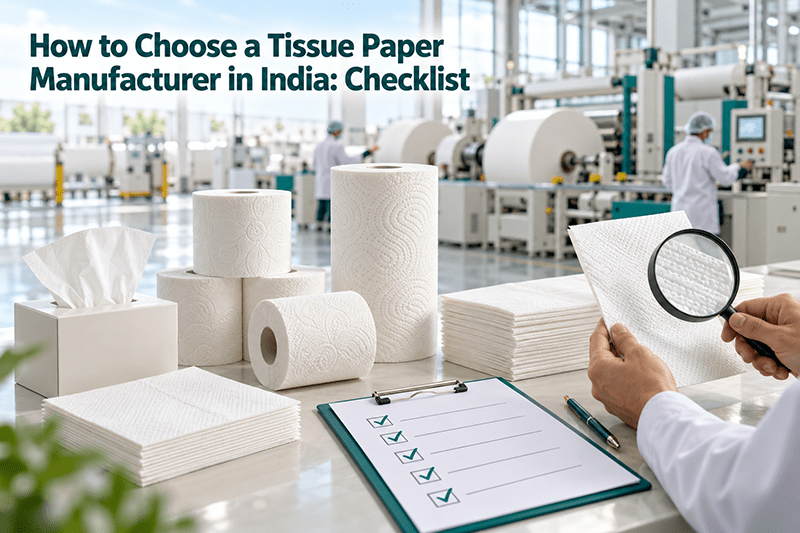
What makes a reliable tissue paper manufacturer in India
Choosing a tissue paper manufacturer in India is a long term decision. The right partner delivers consistent quality, answers questions quickly and ships on schedule, while the wrong one can cost you customers after a single bad container. Price matters, but reliability depends on raw material, process control, certification, packing discipline and export experience. The checklist below helps importers and distributors compare suppliers on the points that actually affect their business.
Take time over this stage. Buyers who rush the choice of supplier often spend far longer fixing complaints, chasing shipments and replacing a partner than they would have spent checking properly at the start.
Start by writing down what matters most to your customers. A hotel supplier cares about dispenser fit and softness, a supermarket buyer about shelf appeal and price per sheet, and a wholesaler about carton strength and container fill. These priorities tell you which parts of the checklist deserve the most attention when you compare manufacturers.
Check the raw material and product construction
Ask whether products are made from virgin pulp, recycled fibre or a blend, because this affects softness, strength, whiteness and hygiene. White Orchid makes its tissue from 100% virgin pulp. Then check construction: ply, GSM, embossing, sheet size and sheet count for toilet rolls, and fold type for M-fold and L-fold tissue. A manufacturer that states these clearly on its quotation is usually one that measures them in production.
Ask how the manufacturer checks incoming parent rolls and how it controls GSM and moisture during converting. Suppliers with real control can explain their in-process checks, how often they test and what happens when a reading falls outside the agreed range. Vague replies such as we always maintain quality tell you very little.
Verify certifications of the tissue paper manufacturer
Certificates show that systems exist and are audited. Look for ISO 9001 for quality management, ISO 14001 for environmental management and ISO 22000 for food safety, which matters for napkins and products used around food. FSC certification supports responsible fibre sourcing claims. White Orchid holds ISO 9001, ISO 14001, ISO 22000, GMP and FSC certifications and is MSME registered. Always check certificate numbers, scope and expiry dates with the issuing body.
Ask also for the Importer Exporter Code and GST registration. These confirm the business is registered to export, and your bank or agent can use them to carry out basic checks before you send any advance payment.
| What to check | What to ask for | Warning sign |
|---|---|---|
| Raw material | Pulp type and source, written on quotation | Vague answers or changing descriptions |
| Certifications | ISO, FSC and GMP certificates with scope | Expired or unverifiable certificates |
| Own production | Factory video call, machine and line details | No access to the factory floor |
| Samples | Samples matching the quoted specification | Samples better than bulk production |
| Export experience | Sample documents, Incoterms offered, ports used | Unclear about export paperwork |
Confirm the manufacturer runs its own converting lines
Many sellers in the tissue trade are traders who buy from different factories. That is not always a problem, but it can mean changing quality from one order to the next. Ask for a live video call of the converting lines, packing area and warehouse. See the parent rolls, the rewinding and cutting machines and the packing process. White Orchid manufactures at Santej, near Ahmedabad, and welcomes buyers to review our infrastructure.
Look at housekeeping during the call. Clean floors, covered finished goods, organised raw material storage and staff wearing appropriate hygiene gear are signs of a disciplined operation. A factory that is careful with hygiene on an ordinary day is more likely to deliver clean, consistent tissue in every carton you receive.
Test samples against a written specification
Request samples that match the exact specification you plan to order, not the supplier's best product. Measure GSM by weighing sheets of known size, count sheets, check roll diameter, perforation strength, softness, lint and absorbency. Keep reference samples and signed specification sheets. When bulk production arrives, compare it with these references. A good tissue paper manufacturer in India will expect this and will ask you to confirm tolerances in writing.
Assess communication, packing and export skills
Notice how quickly and clearly the supplier replies, whether quotations are complete and whether questions are answered in writing. Ask about carton strength, stacking, labelling and container loading plans. A reliable exporter can quote EXW, FOB, C&F (CFR), CIF or door delivery, explain its ports, such as Mundra, Pipavav or Nhava Sheva, and share draft documents before shipment. Poor communication before an order rarely improves after payment.
Ask how the supplier handles a complaint. A clear process, with photos, batch references and an agreed remedy, is a far better sign than a promise that problems never happen.
- Confirm the pulp type and ply are stated clearly on every quotation
- Verify ISO, FSC and GMP certificates directly with the issuing certification bodies
- See converting lines on a live video call before paying any advance
- Keep signed specifications and reference samples for comparison with bulk shipments
- Judge communication speed and clarity before the first order, not after
A dependable tissue supplier is one whose tenth container looks exactly like the approved sample. Consistency, not the first price, is what protects your brand and your customers.
Start small and build the partnership
Even after checks, begin with a trial order or a mixed container. Evaluate product quality, packing, documents and timing, then scale up. Share feedback openly, both positive and negative, because good manufacturers use it to improve. Over time, agree a forecast so the factory can plan raw material and production, which helps keep lead times stable during busy seasons.
Review the relationship every few orders. Track on time shipment, complaint rate, document accuracy and how quickly issues were resolved. Simple records like these make supplier reviews objective and help you decide when to add new products or move to larger containers.
Work with White Orchid as your tissue manufacturer
White Orchid manufactures tissue napkins, toilet rolls, kitchen towels, facial tissue and multi-fold tissue from 100% virgin pulp, with private label options on poly bags, boxes and master cartons. We are appointing importers and distributors in India and overseas. Review our certificates, then send your specification through our contact page or WhatsApp +91 9825109781 to request samples.
Frequently Asked Questions
How can I check if a tissue paper manufacturer in India is genuine?
Ask for a live factory video call, certificate numbers you can verify with the issuing bodies, and the Importer Exporter Code and GST details. A genuine manufacturer shares these readily and explains its production process clearly.
Is virgin pulp tissue better than recycled tissue?
Virgin pulp tissue is usually softer, stronger and whiter, with consistent hygiene, which suits hotels, restaurants and premium retail. Recycled tissue may suit price sensitive segments. Choose based on your customers and positioning.
Which certifications should a tissue supplier have?
Useful certifications include ISO 9001, ISO 14001 and ISO 22000, plus FSC for fibre sourcing claims and GMP for hygiene practices. Check the scope covers the products and site you are buying from.
Should my first order be a full container?
Many importers start with a trial order or a mixed container of several tissue products. This tests quality, packing and documents with lower risk before committing to regular full container orders.