Why distributors build private label tissue products from India
Private label tissue products from India let distributors, retailers and food service suppliers sell under their own brand while an experienced manufacturer handles production. Your brand builds customer loyalty that stays with you, not with a supplier, and you control pricing and positioning. White Orchid offers private label on poly bags, boxes and master cartons, with minimum order quantities, and logo printing on napkins and thermal rolls, also subject to MOQ.
The process is straightforward when each stage is clear. Most delays come from incomplete briefs, late artwork or approvals given in stages, so the sections below walk through what to prepare, what to check and who signs off at every step.
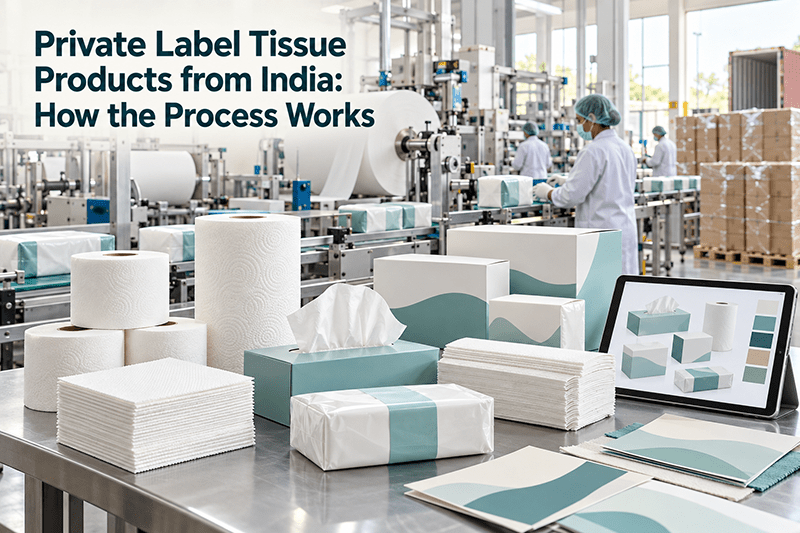
Private label also works at different levels. Some buyers start with a simple branded poly bag on a standard product, then add branded master cartons, boxed facial tissue and printed napkins as the brand gains shelf space. Growing step by step keeps inventory and packaging commitments under control while you test demand.
Step 1: Prepare a private label brief
Start with a short written brief. List each product, such as toilet rolls, kitchen towels or facial tissue boxes, with ply, sheet count, pack size and the packaging format you want. Add your brand name, target market, label languages, barcode needs and any claims you want to print. A complete brief lets the manufacturer confirm feasibility, MOQ and pricing in one round instead of several.
Share photos of competing products you admire, and say what you want to do better, for example softer feel, more sheets or clearer pack information. Name one person on your side who approves artwork and samples. When several people give feedback separately, projects slow down and conflicting instructions reach the factory.
Step 2: Understand MOQ for private label tissue
Minimum order quantities exist because printed packaging is produced in runs, and each design needs its own plates or cylinders and setup. MOQ is usually set per design and per pack size, not per container. If your volumes are modest, start with fewer designs and pack sizes, or use one common design across sizes with a changing size panel. Ask the manufacturer to confirm MOQ in writing for every item before artwork begins.
Think about stock as well as MOQ. Printed packaging that is not used in the first order is usually held for your next one, so plan designs you can keep using. Avoid putting dates, promotions or prices on packs unless you are sure you will use all the printed material within a reasonable time.
| Packaging element | Private label option | Planning note |
|---|---|---|
| Poly bags | Your brand printed on retail bags | MOQ per design and bag size |
| Boxes | Branded facial tissue and napkin boxes | Dieline and board grade confirmed first |
| Master cartons | Your brand, product codes and handling marks | Include barcodes and importer details |
| Napkin printing | Logo printed on napkins | Colours, position and MOQ agreed upfront |
| Thermal rolls | Logo or message printed on roll back | Check printer and receipt layout first |
Step 3: Artwork, dielines and label content
The manufacturer shares a dieline, the flat template showing the exact size, folds, glue areas and safe print zones for each pack. Your designer places the artwork on this dieline in the requested file format, usually vector files with fonts outlined and colours specified. Include the product name, contents, sheet count, dimensions, barcode, country of origin, importer name and address and any required symbols. Local labelling rules vary, so check them in your market.
Keep the design practical. Large solid areas of dark colour can show scuffing in transit, and very small text may blur on flexible poly bags. A good manufacturer will point out such risks before plates are made.
Step 4: Proof approval and pre-production samples
Before printing, you receive a digital proof to check text, barcodes, layout and colours. Read every word, scan the barcode and compare colours against a physical reference if brand colour matters. After you sign the proof, the packaging is printed and a pre-production sample of the finished pack is prepared. Approve this sample in writing, including photos, because it becomes the standard for the whole order.
Allow enough time in your plan for these checks. Rushing the proof stage to save a few days is the most common cause of reprints, and a reprint costs far more time than a careful review. If several markets share one pack, have a local reviewer check each language before you sign.
Step 5: Production, packing and shipment
Once packaging arrives at the factory, tissue is converted, packed into your branded bags or boxes and placed into master cartons. Ask for photos from the packing line and a final loading plan. White Orchid ships on EXW, FOB, C&F (CFR), CIF or door delivery terms, by sea from Mundra, Pipavav or Nhava Sheva, or by air. Your documents will show your company as consignee, with product descriptions matching the private label packs.
For repeat orders, keep the same approved artwork files and simply confirm quantities. If you change any text or colour, treat it as a new design and repeat the proof step, even for small edits such as a new address.
Store the final approved files, proofs and pre-production sample photos in one shared folder. This makes reorders faster, helps new team members understand the range and gives both sides a clear reference if a later batch is ever questioned.
- Send a complete brief with specifications, pack sizes, languages and barcode needs
- Confirm MOQ in writing for every design and pack size before artwork
- Design on the manufacturer's dieline using vector files and specified brand colours
- Check the digital proof word by word and scan every barcode yourself
- Approve a physical pre-production sample with photos before mass production begins
Private label success is decided before a single roll is made. A clear brief, the correct dieline and one careful proof approval save weeks of reprinting and delay.
Build your private label tissue range with White Orchid
White Orchid manufactures private label tissue products from India using 100% virgin pulp, including toilet rolls, kitchen towels, facial tissue and printed tissue napkins, plus logo printed thermal rolls. We are appointing importers and distributors in India and overseas. Share your brand brief through our contact page, email info@whiteorchidtissue.com or WhatsApp +91 9825109781, and we will confirm MOQ and next steps.
Frequently Asked Questions
What is the MOQ for private label tissue products from India?
MOQ depends on the product, pack size and packaging type, because each printed design needs its own run. White Orchid confirms MOQ in writing for every design and size once it receives your brief.
Who designs the artwork for private label tissue packs?
Usually your own designer creates the artwork on the dieline supplied by the manufacturer. The manufacturer checks technical fit and printability, then shares a digital proof for your approval before printing.
Can I print my logo on napkins and thermal rolls?
Yes. White Orchid offers logo printing on napkins and thermal rolls, subject to MOQ. Agree colours, logo size and position upfront, and check thermal roll printing against your printer and receipt layout.
What should my private label tissue packaging include?
Include product name, contents, sheet count or dimensions, barcode, country of origin, importer name and address and any required symbols or languages. Confirm local labelling rules with your authority or adviser.