
Why tissue GSM, ply and sheet count matter to importers
When an importer compares quotations for napkins or toilet rolls, three numbers decide most of the value: tissue GSM, ply and sheet count. Two offers can look identical on a price sheet yet deliver very different amounts of paper per carton. Understanding these specifications lets you compare suppliers fairly, write clear purchase orders and avoid disputes after the container arrives. This guide explains each term in plain language and shows how to check them on samples and at inspection.
What GSM means in tissue paper
GSM stands for grams per square metre and measures the basis weight of the paper. A higher GSM usually means a thicker, stronger sheet, but softness depends as much on pulp quality and creping as on weight. Kitchen towels generally run heavier than toilet tissue or facial tissue because they must absorb spills without tearing. Always ask whether a quoted GSM refers to one ply or to the finished multi-ply sheet, because suppliers do not always state it the same way.
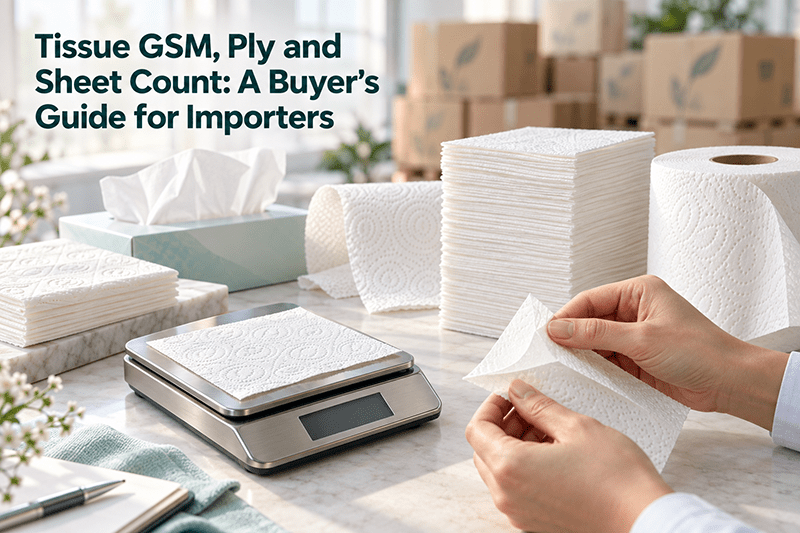
GSM should be measured on conditioned samples, since tissue absorbs moisture from the air and gains weight in humid conditions. A simple check is to cut a sample of known area, weigh it on a precise scale and calculate grams per square metre. Repeat the test on several sheets from different rolls. Small variation is normal in any paper machine, so agree an acceptable tolerance with your supplier rather than expecting every sheet to hit an exact figure.
Ply: one, two or three layers
Ply is the number of layers bonded together in each sheet. One ply suits budget institutional use, two ply is the common retail standard for toilet rolls and napkins, and three ply is positioned as premium. More plies add bulk, absorbency and a softer hand feel, but they also raise paper consumption per roll. A two ply sheet of lower GSM can feel better than a heavy one ply sheet, so judge ply and GSM together rather than in isolation.
Sheet count, sheet size and roll length
Sheet count tells you how many sheets are on a roll or in a pack, while sheet size gives the length and width of each sheet. Multiply the two and you get the real paper area, which is the fairest basis for comparing offers. A roll with more sheets but a shorter perforation gap may contain less paper than a rival. For toilet tissue rolls and kitchen paper towels, ask for sheet count, sheet dimensions and total roll length.
A quick calculation shows why this matters. Imagine one offer of 300 sheets measuring 100 by 100 mm and another of 280 sheets measuring 100 by 120 mm. The first roll gives 3 square metres of paper, the second gives 3.36 square metres, even though its sheet count is lower. Multiply the area by GSM and ply and you know the paper weight per roll, which you can then compare across every supplier on your shortlist.
| Specification | What it measures | How to check it |
|---|---|---|
| GSM | Weight of paper per square metre, per ply or total | Weigh a cut sample of known area on a precise scale |
| Ply | Number of bonded layers in each sheet | Carefully separate the layers at one corner |
| Sheet count | Number of sheets per roll or pack | Count one complete roll or pack by hand |
| Sheet size | Length and width of each sheet in millimetres | Measure several sheets with a steel rule |
| Roll diameter and core | Outer size and inner core of the roll | Measure with calipers and compare with the carton marking |
Applying tissue GSM, ply and sheet count to each product
Each product family uses the specifications differently. For tissue napkins, buyers look at unfolded size, fold type, ply and count per pack. For facial tissue, softness and sheets per box matter most, while M-fold and L-fold tissue is judged on sheets per bundle and dispenser fit. Toilet rolls and kitchen towels depend on sheet count, roll length and absorbency. Write the right set of numbers into every enquiry.
Pulp source also changes how the numbers perform. White Orchid tissue is made from 100% virgin pulp, which gives consistent fibre length, brightness and strength. Recycled blends can reach a similar GSM on paper yet feel harsher or shed more lint. When you receive samples from any supplier, compare them side by side at the same ply and similar GSM, and test tearing, absorbency and softness with the people who will actually sell or use the product.
Common mismatches to watch for
Most disputes come from vague specifications rather than bad intent. A quotation may state sheet count without sheet size, or quote total GSM when you assumed per ply. Roll diameter can be maintained by winding the paper looser, so the roll looks full but carries less paper. Pack counts may be rounded, and heavy embossing can make a thin sheet appear thick. Clear written specifications, approved reference samples and a simple tolerance clause remove almost all of these risks.
Compare tissue offers on total paper area and weight per carton, not on roll count alone. A clear specification sheet protects both buyer and seller when the container is opened.
- State GSM per ply and total GSM clearly on every purchase order.
- Specify sheet size in millimetres along with the exact sheet count per roll.
- Agree roll length, roll diameter and core size before production begins.
- Keep sealed, approved reference samples on both sides for later comparison checks.
- Write an agreed tolerance for weight and count into the sales contract.
Using tissue specifications to position your range
Specifications are also a sales tool. Many distributors build a three tier range: an economy line for institutions and cleaning contractors, a mid range for supermarkets and a premium line for hotels and gift retail. White Orchid toilet rolls, for example, run from Eco through Comfort 350 and Comfort 500 to Super Soft, which makes it simple to offer good, better and best options from one supplier. Clear numbers on the pack also help retailers justify shelf prices.
Work with White Orchid on the right tissue specifications
White Orchid manufactures tissue napkins, toilet rolls, kitchen towels, facial tissue and multi-fold tissue at Santej, near Ahmedabad, under ISO 9001, ISO 14001, ISO 22000, GMP and FSC certification. Share your target market, preferred ply and pack format, and our team will propose matching specifications and send samples for evaluation. Review our certificates, then contact us or WhatsApp +91 9825109781 to discuss becoming a distributor.
Frequently Asked Questions
Is higher GSM tissue always better quality?
Not always. Higher GSM adds weight and strength, but softness depends on pulp, creping and ply. A well made two ply sheet of moderate GSM often feels softer than a heavy one ply sheet.
How do I compare toilet rolls with different sheet counts?
Multiply sheet count by sheet length and width to get paper area per roll, then factor in GSM and ply. This gives a fair comparison even when sheet counts and sizes differ between suppliers.
Should GSM be quoted per ply or for the whole sheet?
Either can be used, which is why confusion happens. Ask the supplier to state both per ply GSM and total GSM on the specification sheet and purchase order so there is no misunderstanding.
Can White Orchid match an existing tissue specification in my market?
Yes, share the ply, sheet size, sheet count and pack format you currently sell. White Orchid can propose a matching specification and send samples for your evaluation before any order is placed.