
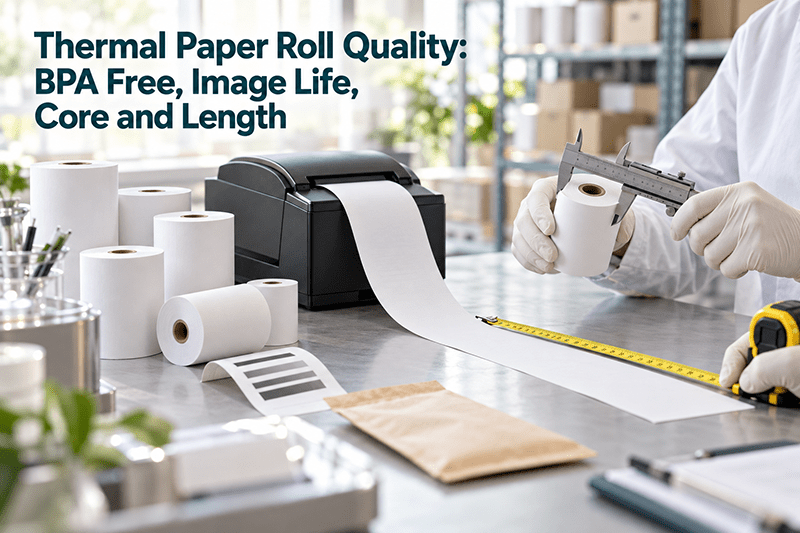
Why thermal paper roll quality matters
Thermal POS rolls look simple, but every shop, restaurant and bank that uses them notices poor quality quickly. Faded receipts, jammed printers and rolls that run out early all damage a distributor's reputation. Thermal paper roll quality comes down to five checks: coating chemistry, print density, image life, core size and true roll length. This guide explains each one so importers can compare suppliers properly and protect repeat business with their retail and hospitality customers.
BPA free coating and regulations
Thermal paper carries a heat sensitive coating that turns dark when the print head heats it. Older coatings used Bisphenol A (BPA) as a developer. The EU restricted BPA in thermal paper from 2020, and many retailers elsewhere now ask for BPA free rolls as a precaution for cashiers who handle receipts all day. White Orchid thermal POS rolls are BPA free. Importers should request the supplier's coating declaration and, where their market requires it, a supporting test report.
Be careful with the wording on specification sheets. Some papers replace BPA with other developers, and a few markets and retailers apply their own lists of restricted substances as well. Ask the supplier to name the grade you are buying, confirm in writing that it is BPA free and keep that declaration on file with your batch records. Retail chains and banks increasingly ask distributors for exactly this document during supplier approval.
Print density and image life
Print density describes how dark and sharp the image looks when printed. A good roll gives crisp barcodes and clear small text at normal printer settings. Image life describes how long the printed receipt stays readable. It depends on coating quality and storage conditions, because heat, sunlight, plastic sleeves, oils and some adhesives speed up fading. Customers who keep receipts for warranties or accounts care about this, so ask how the supplier describes image life for each grade.
A practical test is to print the same receipt on sample rolls from each supplier, then store one copy in a drawer, one near a window and one inside a plastic sleeve. Compare them after a few weeks. Also scan printed barcodes with a standard scanner. This simple comparison often reveals more about thermal paper roll quality than any brochure claim and gives you real evidence to share with your buyers.
Core size and printer compatibility
The core is the tube at the centre of the roll. Its inner diameter must fit the spindle or holder of the printer, and some card terminals need very small cores or coreless rolls. Outer roll diameter matters too, because a roll that is too wide will not close inside the printer cover. Before ordering, list the printer and terminal models common in your market and match core size and maximum outer diameter to them.
Core quality also affects performance. A weak or crushed core can make the roll wobble, feed unevenly or stick near the end. Some rolls carry a coloured end of roll warning stripe so staff know when to change the roll before a receipt is cut short. Check that the paper is wound tightly and evenly, with clean edges that will not shed dust into the print head and shorten its working life.
Roll length: the most common thermal paper roll quality problem
Short length is the most frequent complaint in the thermal roll trade. A roll sold as 3 1/8 inch x 230 ft may contain noticeably less paper if the supplier reduces length to cut cost. Because the core and outer diameter hide the difference, buyers rarely notice until customers complain. The fix is simple: agree the stated length, weigh sample rolls, and unroll and measure a few rolls from each shipment. Paper GSM also affects weight, so confirm it too.
| Roll size | Typical use | What to confirm |
|---|---|---|
| 3 1/8 inch x 230 ft | Retail and restaurant receipt printers | Core size and outer diameter for the printer |
| 3 1/8 inch x 265 ft | High volume checkouts needing fewer roll changes | Fit inside printer cover |
| 3 1/8 inch x 150 ft | Compact receipt printers and kiosks | Printer model compatibility |
| 2 1/4 inch x 50 ft | Card terminals and portable devices | Small core or terminal holder fit |
| 2 1/4 inch x 85 ft or 150 ft | Terminals, taxi meters and mobile printers | Outer diameter limit of the device |
A thermal roll is judged at the till, not in the warehouse. Short length or faded print costs a distributor far more in lost trust than it ever saves in price.
Packing, storage and branding
Thermal paper reacts to heat and light, so packing matters. Rolls should be shrink wrapped in small packs and packed in strong master cartons that survive sea freight and humid warehouses. Store cartons away from direct sunlight and heat sources. Many distributors also sell printed rolls with a retailer's logo or promotional message on the reverse. White Orchid offers logo printing on thermal rolls with an MOQ, which can create a higher value product line.
Private label packs are another option. A distributor can sell thermal rolls under its own brand on shrink wrap and master cartons, supplying stationery wholesalers, payment terminal companies and retail chains from one consistent range. Pairing rolls with office consumables widens the order. Once your brand is known for correct length and clear print, customers stop comparing only on price and start reordering on trust.
- Ask for a BPA free coating declaration and relevant test reports for your market.
- Print test receipts and compare print density and barcode scanning on each sample.
- Match core size and outer diameter to printers and terminals used locally.
- Weigh and measure sample rolls to confirm the stated length before ordering.
- Check shrink wrapping and carton strength for long sea freight and humid storage.
Classification and import paperwork
Thermal paper rolls are often classified under HS heading 4811 or 4823 depending on their form and the way customs in your country interprets the product. Always confirm the exact code and duty on your official tariff tool, such as EU TARIC, the US HTS or the UK Trade Tariff, or ask a customs broker. Correct classification avoids delays and unexpected costs when the container reaches port.
Source quality thermal rolls from White Orchid
White Orchid manufactures BPA free thermal POS rolls in 3 1/8 inch and 2 1/4 inch widths at Santej, near Ahmedabad, alongside A4 copy paper for office supply distributors. Tell us your printer types, preferred lengths and packing, and we will send samples for testing. Please contact us or WhatsApp +91 9825109781 to discuss distribution in your market.
Frequently Asked Questions
How can I check that a thermal roll has the stated length?
Unroll and measure a few sample rolls, and weigh rolls against a verified reference roll of the same GSM and core. Repeat on random rolls from each shipment to confirm consistency.
Why do some thermal receipts fade quickly?
Fading depends on coating quality and storage. Heat, sunlight, plastic sleeves, hand creams and some adhesives speed it up. Better coatings and proper storage help receipts stay readable for longer.
Is the coating on White Orchid thermal paper rolls free of BPA?
Yes, White Orchid thermal POS rolls are BPA free. Importers can request coating declarations and discuss any additional test reports their market or customers require before ordering.
Can thermal rolls be printed with my customer's logo?
Yes. White Orchid offers logo printing on thermal rolls with a minimum order quantity. Printed rolls help distributors offer banks, retail chains and restaurants a branded, higher value product.