
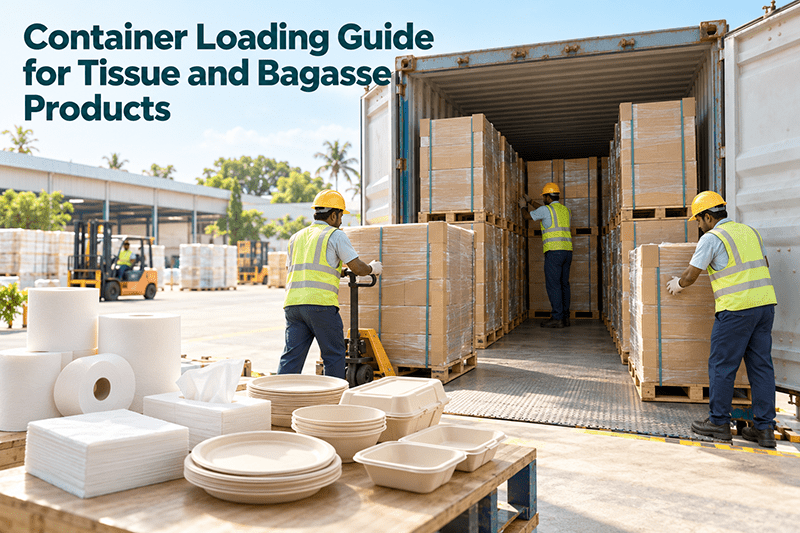
Why a container loading guide matters for paper goods
This container loading guide is written for importers of tissue and bagasse products, two categories that fill space long before they reach weight limits. A container of toilet rolls or clamshells is almost always full by volume while carrying a fraction of its permitted payload. That means the way you choose container size, carton dimensions and stacking pattern has a direct effect on how many units you land and what each one costs.
Unlike dense goods such as ceramics or steel, paper products reward careful space planning. A few centimetres saved on carton height, or a better stacking layout, can add a whole extra row of cartons. The sections below explain the standard container options, how to estimate capacity yourself, and how mixed loads work.
20 ft vs 40 ft vs 40 ft high cube containers
Three container types cover almost all tissue and bagasse shipments. The 20 ft standard suits trial orders and smaller distributors. The 40 ft standard offers roughly double the volume for a freight rate that is usually well under double. The 40 ft high cube (HC) is about 30 cm taller, which gives valuable extra space for light cargo that can be stacked high without crushing.
| Container | Internal volume | Practical loadable volume | Typical use |
|---|---|---|---|
| 20 ft standard | About 33 CBM | About 26 to 28 CBM | Trial or mixed orders |
| 40 ft standard | About 67 CBM | About 54 to 58 CBM | Regular distributor orders |
| 40 ft high cube | About 76 CBM | About 62 to 68 CBM | Tissue and bagasse at best cost |
For most tissue and bagasse importers, the 40 ft high cube delivers the lowest cost per carton because the extra height is used fully. Some ports and inland routes have restrictions on high cube equipment, so confirm availability with your forwarder before planning around it.
Volume vs weight: which limit you will hit first
Every container has a maximum payload, typically well above what a full load of tissue weighs. A 40 ft HC packed with toilet rolls or napkins may carry only a few tonnes, far below its payload rating. Bagasse tableware is similar. Only denser items such as copy paper reams and thermal POS rolls start to push the weight side, and even then usually in a mixed load rather than a full container.
Road limits matter too. Some countries restrict the gross weight of a loaded container on highways, which can be lower than the container rating. If your load includes copy paper, check local axle and gross weight rules for the final truck leg before finalising quantities.
How to estimate cartons per container yourself
We do not publish fixed carton counts, because every order differs by pack format, carton size and private label design. You can make a reliable estimate. Multiply carton length, width and height in metres to get CBM per carton. Divide the practical loadable volume of the container by that figure. The result is a starting estimate, which the loading plan then refines by testing orientations.
For example, a carton measuring 0.60 x 0.40 x 0.45 m is 0.108 CBM. Divided into roughly 65 CBM of usable space in a 40 ft HC, that suggests around 600 cartons. The real count may be a little higher or lower once carton orientation, door clearance and stacking limits are applied, so always ask for a confirmed loading plan.
Stacking strength and carton design
Light cargo still needs strong cartons. The bottom layer in a high cube supports the full height of the stack for weeks at sea. Master cartons for toilet tissue rolls and M-fold and L-fold tissue should be sized so they fill the container width and height with minimal gaps, which reduces shifting and corner damage during transit.
Carton board grade matters as much as size. Humidity at sea softens corrugated board, so a carton that feels strong in a dry warehouse can lose much of its strength after weeks in a warm container. Ask for export grade master cartons, and avoid overhanging cartons at stack edges, because unsupported corners are where crushing usually begins. Good cartons also make the unloading team faster and safer.
With tissue and bagasse, you are buying cubic metres, not tonnes. Every centimetre saved on carton design is freight you no longer pay for.
Planning a mixed container of tissue and bagasse
Many distributors combine categories in one container to widen their range without over stocking a single item. A typical mix might combine tissue napkins, facial tissue boxes, bagasse clamshells and bowls. The loading plan groups each product in blocks, heaviest at the floor, so cartons are easy to count at customs and unload by product at your warehouse.
- Place copy paper and thermal rolls on the floor as a stable base.
- Load bagasse cartons in blocks, keeping them away from the damp door end.
- Stack light tissue cartons on top where crushing risk is lowest overall.
- Label every carton with product code so warehouse staff can sort quickly.
- Match the loading plan, packing list and invoice exactly before sealing.
Mixed loads are also a smart way to test new lines. A distributor established in napkins can add a few blocks of bagasse bowls or thermal rolls, measure how they sell, and adjust the mix on the next container without committing to a full load of an unproven product.
Container loading guide checklist before you order
Share your intended product mix and pack formats with your supplier early. Ask for carton dimensions, gross weight per carton and a proposed loading plan for your chosen container. Confirm whether goods will be floor loaded or palletised, since pallets make unloading faster but use space. Floor loading usually fits more cartons, which matters for light paper cargo.
Also think about the unloading end. Check how long your warehouse needs to empty a floor loaded 40 ft HC by hand, and whether the free time at the port and depot covers it. Demurrage and detention charges can quickly erase the savings from a well packed container if unloading is slow or poorly planned.
Get a container load plan from White Orchid
White Orchid prepares loading plans for full and mixed containers of tissue, thermal rolls, bagasse tableware and copy paper, shipped from Mundra, Pipavav or Nhava Sheva. Send us your product list, pack sizes and destination, and we will suggest the best container type with an estimated carton count. Contact our export team or review our certifications before you plan your first load.
Frequently Asked Questions
How many cartons of toilet rolls fit in a 40 ft high cube container?
It depends on carton size and pack format. Divide the usable volume, roughly 62 to 68 CBM, by the CBM of one carton to get an estimate, then ask White Orchid for a confirmed loading plan for your exact specification.
Should I choose a 40 ft or 40 ft high cube for bagasse tableware?
A 40 ft high cube usually gives the lowest cost per carton for bagasse because the load is light and the extra height is used fully. Check that high cube equipment is accepted on your destination port and road route.
Will a container of tissue products reach the weight limit?
Rarely. Tissue and bagasse fill the container by volume long before its payload limit. Only loads with a large share of copy paper or thermal rolls need a careful weight check against road limits at destination.
Is it better to palletise or floor load tissue cartons?
Floor loading fits more cartons and lowers cost per unit, which suits light paper goods. Pallets speed up unloading and reduce handling damage. Many importers floor load and unload by hand, while larger warehouses prefer pallets.